Sunday, March 10, 2013

Don't Dis the Diss -- Part I


So, I made a resolution to post a blog entry once each week, and it’s only March and I’ve failed miserably. I blame it on my dissertation, and for that reason, this post is all about that very special piece of writing in my life.

The dissertation is a strange thing. For many of us, it is a mythological beast of sorts—the unicorn of grad school. Just when you think you see it in its entirety, it dissolves into the forest of commentary, criticism and revision. In some ways, perhaps a dissertation is more of a hippogriff. It is an unwieldy fusion of degree requirement and serious research project; a not-quite-book but more-than-term paper.

Finishing the dissertation and applying to jobs bring a whole new layer of anxiety to the graduate student. We begin graduate school happy to have gotten in, privileged to join the ranks, but often also with a sense of smugness. We were encouraged by someone, by several people, at some point in our young and impressionable lives, to get a PhD. To go to graduate school. Because we were smart, maybe even very smart. Unfortunately smartness is pretty easy to come by in graduate school. By the time you make it into a PhD program, you are no longer the smartest person among your peers. Everyone is the smartest person, and there are very few compliments or encouraging comments to go around, especially once you finish your coursework and start working on your dissertation project.

Academia is full of egos, so you have to make sure to stroke your own as often as you can, or find someone who will stroke it for you on a consistent basis. We also have to delude ourselves a little bit about the job market—surely, we say to ourselves, we will get jobs! We will not be those sad sad phds you hear about who gave up on academia and now drive a truck for a living, or, god forbid, live off of food stamps while adjuncting somewhere! We tell ourselves over and over again that what we are doing is worthwhile, honorable, and maybe even necessary. After all, someone has to educate college students about the beauty of Shakespeare’s language, the humor of Chaucer’s tales, the beauty and the wit of Woolf’s prose, and the complex symbolism of the Brontës, Hurston, Morrison, Faulkner and so many others.

Of course, that’s not really what the dissertation is about. I remember very clearly attending my own undergraduate English department graduation ceremony back in the day. The English department ceremony included the PhDs, MFAs and MAs in addition to the BAs. The PhDs went first. I remember this one female student particularly because my senior seminar professor was hooding her. I don’t remember the exact title of this young scholar’s dissertation, but I know it had something to do with a medieval woman writer I’d never heard of.

“How lame!” I thought. “Why write a dissertation about some piece of literature no one has every heard of!?” At some point I’d also heard jokes about over-specialized dissertation topics, topics so obscure no one had seemed to have heard of them. It all seemed so…ridiculous! Why bother in that case? Why not write about all your favorite novels or poems or plays or authors?

And yet here I am, nine years older and wiser, with the knowledge that the dissertation, “Why Jane Austen is Amazing,” and dissertations similar to that, have pretty much already been written. A dissertation has to make a significant intervention into a complex, some might say bloated, field of inquiry that is specific enough that you can do the research on it in 3 years, more or less. Anything bigger, more all-encompassing, or more complex will take longer than the six long years it already takes to do a PhD in English “quickly.” (The national average is somewhere around 9 or 10 years.)

At the same time, people often naively ask me, “What could possibly be left to say about ________?” (fill in the blank with a well-known author or work). Theoretical and social ideologies are changing constantly, meaning that our interpretations are changing constantly as well. The study of literature is all about looking for patterns of signification and for new ways to understand ourselves and the world around us as portrayed through literature. In the past, different literary schools attempted to justify why some works were “Literature” and others weren’t; others traced the psychoanalytic resonances in literature; still others inspected works of literature for signs of class struggle or representations of racial inequality; others analyzed the structure and narrative of works of literature as well as the ways in which readers responded to these works; and others search for the representations of unusual men and women, non-normative sexualities and gender configurations, and how literature creates a space for understanding these ideas and developments now and in the past.

Given the ever-changing mindset of literary scholars, as well as the constant re-evaluation of past works of literature and the discovery of ever more under- or un-studied works by both canonical authors as well as newly rediscovered ones, the stream of knowledge to be produced in literary studies is probably endless.  Just as scientists will keep studying space and sub-atomic structures and the deepest trenches of the oceans in order to keep searching for what we still don’t know about the material world, so literary scholars will keep studying creative works to identify and analyze what we still don’t know about the human condition.

But I wax poetic. The dissertation is often an un-poetic creation. It is Frankenstein’s monster, in a way. We piece it together, learning how it works as we go along. For most of us, this is the longest piece of analytical writing we have ever done (unless this is your 2nd PhD, in which case, go away). It’s difficult, at times; at other times, things seem to go swimmingly. Then you get your committee’s comments, and for a while you might feel like you are right back where you started. But you have to keep plugging along, because they aren’t paying you enough to linger (or at least not where I go to grad school). Plus, somewhere in the future is the end of the rainbow with the ultimate pot of gold: a job as a real live professor of English literature where you will get to continue your research (hopefully on a reasonable salary) while you inspire young minds, engineer new syllabi, and become the intellectual equal of the people you admire.

The dissertation is not a book; it is not “publishable” as such. It might have been, in the past, when dissertations were longer, people spent longer in graduate school, and the state of the academy was quite different (for ex. you could start a tenure-track job while still working on your dissertation). Now it is a significant research project that will eventually become your first book (maybe. It might also just turn into 3-5 articles). How that process works, I’m not quite sure. I imagine it involves some time in an archive, among other things…

For now, the defense copy of my dissertation is done and I await my defense date. Then there will be final revisions and the official submission to the Graduate School. In the meantime, I am thinking a lot about what it means to have written it. Of course I am proud of it. It’s nearly 250 pages long. It has a 17 page works cited list. I have spent 3 years working on it, while also teaching, working on scholarly articles, attending conferences, writing letters of recommendation, attending meetings, and applying for 60+ jobs.

On the other hand, the dissertation still feels unfinished; maybe it will always be that way. Maybe even once it’s a book, it will still feel unfinished. Writing, when done well, is a lengthy process. I’ve missed writing creatively in the last 6 years, but the PhD sucks up nearly all your time and energy for that. On the other hand, I’ve enjoyed writing my dissertation, coming up with new ideas and ways of interpreting these works, and discovering strange and sundry literary marginalia to expose to the world…

I do know, however, I’m ready to be finished with graduate school and move on.

Stay tuned for Part II, in which I reveal the topic of my dissertation & revel in the details!
-UK

Thursday, February 14, 2013

Animal Celebrity is a Bitch


So, many of us were distracted from our workaday lives recently by the Westminster Kennel Club Dog show—what, you weren’t watching? (The winner was Banana Joe, the first ever affenpinscher to win this particular event—now he gets to retire in everyone’s favorite retirement spot, the Netherlands.) Of course, events like this one and the National Dog Show on Thanksgiving only make me think of one thing—Christopher Guest’s brilliant mockumentary Best in Show and Parker Posey’s amazing “Where is Busy Bee?” meltdown therein—but it did recently get me thinking of something else. Namely—the fact that man’s best friend is definitely not the hottest animal on the block, and it hasn’t been for some time.

These days it takes more than being a friendly, tail-wagging quadruped to be “trending” at the rate of other species. In fact, the pop culture popularity of dogs is probably below that of even monkeys. People who watch videos of dogs—or the dog show—seem quaint and old timey.

For those of you who aren’t aware of the latest species trending, this list should help you get back up to speed. Dogs may be cute, but they are just not that hip anymore. Dogs had the 90s: Budweiser’s Spuds Mackenzie, the Taco Bell Chihuahua, and the Saint Bernard Beethoven ruled the big and small screens. Now they, like bunnies (think Energizer or Cadbury’s), must scamper for attention (the puppy-party-favors of Bridesmaids were an notable and adorable exception).

7. Penguins & Meerkats—yesterday’s news

Hard to believe that just a couple of years ago, penguins and meerkats reigned supreme. Who would have thought their day in the sun would ever end? However, all good things must come to an end. With Happyfeet and March of the Penguins now just DVDs gathering dust, and Meerkat Manor a mere memory, those animals are on the downswing. Enjoy them while the youtube videos still exist!
Meerkats watch as fame & fortune leave them.

 6. Honeybadger—flash in the pan

Honeybadger don’t care….honeybadger is a badass!

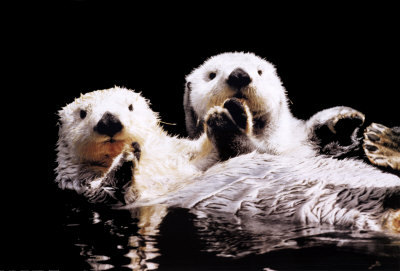
5. Sea otters—just for Valentine’s Day?

A furry, graceful animal that holds hands with its friends? An instant winner. The jury is still out as to the market power of sea otters in the long run, but they are the perfect animal celebrity for the “yay I’m not a sad singelton” marketing campaign that is Valentine’s.

That looks says: "We know we're cute."


4. Pigs—on the rise

We thought we'd seen the end with the demise of Babe, but they're back! Who can resist Hamlet the pig making his way down the stairs towards his oatmeal? Or how about that somewhat creepy talking pig in the Geico commercial? Any way you slice it, pigs are on the rise and going quite literally into the skies. Pretty soon, these pigs will be bringing home the bacon, big time.

3. Hedgehogs—so cute I can barely breathe

OMG OMG OMG. Hedgehogs!!!! Cute and prickly and just oh-so-squishy! Lounging in my hand! Going for a swim! Gaaaah!

2. Sloths—hitting the big time

Sloths are smelly, slow and kind of scary—obviously a natural choice for fame and fortune. The Zach Galifinakis of the animal world, let’s say. But better-looking, because apparently, Bradley Cooper looks like one. Actress Kristin Bell is crazy for sloths. HuffPost announced today that a great last-minute Valentine’s gift would be a bucket of sloths. Sloths have even had their own SNL video. Obviously, sloths have arrived…get ‘em while they’re hot!...or still in the bucket!

This bucket's mine! Get your own!

 1. Cats—always in fashion

None of these animals, however, will ever attain the popularity of the Internet darling—cats. Cats sliding into boxes, cats making existential statements, cats playing the piano, or even people just singing about cats. We even love grumpy cats. A self-teaching computer programmed to analyze the internet was able to “learn” how to recognize consistently exactly one thing—cats. Internet cat videos have even been shown at exclusive cat video film festivals. Cats are simply the Chanel of the animal world—always stylish and always classy with a little bit of sassy. 

But all you dog-lovers out there, have no fear. Dogs are here to stay, too, even if they aren't lapping the limelight in quite the same way as cats or sloths. And here are some dog gifs for you too.

The Great Conjunction's very own grumpy cat.
--UK

Monday, February 4, 2013

New Year, New Rules: New Year's Resolutions, 2013 Edition


So, I’m a sucker for New Year’s Resolutions. As an academic, I usually make them twice a year—on January 1st, like “normal” people, and again on September 1st, with the beginning of the new academic year. The resolutions I make at the start of September often have to do with my academic achievements and work ethic; while these figure in my January resolutions, I try to add the “life improvements” resolutions to this list as well.

As usual, my list is ambitious, unrealistic and unoriginal: manage my time more effectively; be more courteous to others, especially as a listener; don’t let the little things upset me; eat more healthily; work out more consistently; be a more enthusiastic and engaged instructor; stop procrastinating; get back to writing fiction; read more books for fun. (Naturally I’m most excited by the last one on that list.)

But I can’t help myself. I like to reinvent and improve myself, even when I know that these goals are a constant struggle to maintain. But I also love making lists. I make to-do lists, grocery lists, book lists, move lists, lists of achievements, lists of failures, pro and con lists, and, as you are witnessing in this essay, lists of lists. I have a notepad for making lists and at the bottom it says, “Make a list—you’ll feel better.” If nothing else, making lists makes you feel in control, even if that’s a false sense of satisfaction.

I am also very meticulous about my lists. I joke that lists are where the Virgo in me really comes out. Not only do I like to make lots of lists, I organize my lists with categories and subcategories. I like to make my grocery lists in order of how the food is laid out in the grocery store that we go to every week. What—you don’t do that? For Christmas shopping this year, I created an Excel spreadsheet to make sure I had all the recipients and their gifts listed. I have no doubt this list will prove invaluable in ten months’ time.

But back to resolutions! Resolutions are a neat and orderly list of things I wish to achieve, however esoteric, abstract or concrete. The key to effective goal-setting is, of course, to make a second list that describes what you will do in your life to achieve these goals (I think I read that in a book or Good Housekeeping, which mysteriously keeps being sent to my house). For example, for my resolution of working out more consistently, I will promise myself to work out 4-5 times a week minimum, with roller derby twice a week, gym twice a week, and, once the weather gets nicer, running twice a week. In order to get fitter, I plan on using a fitness journal to mark my progress and make sure I’m upping the weight on the machines every month.

The problem with this method is once you get to the more abstract resolutions. For example—how do I break my bad habit of interrupting people and, in general, being a bad listener? How do I “manage my time better” (aside from making more lists)? How do I commit to “not letting the little things get to me” or “being a more enthusiastic instructor”? The only way to do that is to remind myself as often as possible about these things. My original idea was to write myself reminders of these goals in my day planner and on a sheet of paper by my bed—but then I put that off.

I suppose in the end it doesn’t matter if you break your resolutions, as long as you don’t break your resolve. I’m not a fan of self-help books, so I’ll leave the pep talk for someone else. As far as I’m concerned, I’ll keep making and re-making myself as often as I can—that’s one resolution I know I’ll keep. And when that fails, I’ll make a list…and I’ll feel better.

[Try not to notice that I already broke resolution #37, post to blog every week….] 

Friday, September 14, 2012

The Dirty Thirty


I turned 30 a couple weeks ago, and it’s made me a bit reflective. Lots of people freak out about turning 30, but I haven’t really had the jitters about it. Maybe it’s because my other half turned 30 a while ago and it took some of the sting out of the whole thing. I like to think it’s because I’m mature and adult-like and don’t worry about things like aging or mortality.

But of course I do. 15 years ago I was 15, and it seemed like hot shit to be 15. Like a major accomplishment. It also seemed like a long time still to come before I would be an independent adult, free from parental supervision, with a life and money of my own. That wasn’t even on my radar. But those second 15 years flew by. I can hardly believe it. Time is nothing to me now; time just flows by unchecked, except maybe when I’m in the dentist’s chair.

I don’t want this to be my reflections on immortality here; I’ll leave that to Mr. Wordsworth. Instead, I’ve been trying to think of all the things I’ve learned in my 20s, my own belated coming-of-age. I’ve been an adult (sort of) for the last 10 years, and I think I have accomplished and learned quite a bit. Since I like summing things up and making lists, indulge me this once…

Things I Have Accomplished in the Last 10 Years:
·         I have traveled the world (multiple countries, 3 continents, several states)
·         I have brought my total # of languages to 5
·         I have completed a BA & MA & am < 1 year away from a PHD
·         I have fallen in love & gotten married
·         I have acquired a cat
·         I have won awards, published a paper, and presented at multiple conferences
·         I have befriended my grandmother
·         I have made some of the best friends of my life
·         I have gotten in shape (more or less)
·         I have lived in New York City
·         I have written a novel (even if it’ll never be published, that’s still an accomplishment!)
·         I have lived in Europe
·         I have joined a roller derby team J

Things I Learned in the Last 10 Years
·         Staying home on Friday night is nice
·         My parents were right about a lot of things, including making my bed every day
·         It’s not the end of the world when you lose a friend
·         It’s not the end of the world if people don’t like you
·         I really don’t care what anybody else thinks
·         It’s not where you live, it’s what you make of it and who you surround yourself with that counts
·         Every job has its down sides
·         Compromise is necessary and not always painful
·         There are better wines than White Zin
·         Quality over quantity
·         Research can be fun
·         People are unreliable, close-minded, and self-serving, but that’s not the end of the world either
·         Your true friends will always be there even if you lose a lot of friends along the way
·         Being disciplined is sometimes more important than being smart
·         Being smart doesn’t make you better than other people
·         There are many ways to be happy
·         My tastes, interests and dislikes are constantly changing and capable of being changed
·         No one has life “figured out” and there’s no pressure if I don’t either
·         I may never learn how to stop saying stupid things but most people are pretty forgiving

OK, enough with the nuggets of wisdom. I’ll stop here go back to my wine. Not White Zin.  

Tuesday, July 17, 2012

“Talk Derby to Me”


So, I can’t take credit for that phrase, but I can officially say that I am a Derby Girl! A bona fide skate-owning, dues-paying, sweating-it-out-in-the-heat derby girl! This is very exciting, for a number of reasons:

1.      Derby girls are bad ass. The whole point of the sport (it is a sport…see #2) is to be a badass: you can knock people over, rock some badass fashion (see #3), skate really fast, and make falling look painful and cool. When I used to go to bouts, if I was in the bathroom and some derby girls came in, I would immediately feel simultaneously intimidated by and jealous of their coolness. Now I’m that girl! Or, I will be once I’m scrimmage-ready. Subpoint 1A: Once you are scrimmage-ready, you get to choose your DERBY NAME, usually something tough and witty. What is more badass than that?
Drew Barrymore's film Whip It is all about roller derby. This film is how I first found out about derby. Is there anything cuter than their outfits!? The team in the film is the "Hurl Scouts." Ellen Paige may be precious, but the movie's derby scenes are awesome.

2.      For the first time in my life, I’m an athlete! No, really. I go to 2 practices a week right now, each of which lasts 2 full hours, during which I sweat buckets, consume nearly a gallon of water, squat almost without break, sprint around the track, block other players, jump on my skates, hit and get hit by other team members. It’s hard work! I have no idea how many calories 2 hours of skating like that burns—1,000? It feels like it anyway! After practice, I usually guzzle a sports drink, and it usually feels like the best thing I ever drank. Subpoint 2B: Just in case you were wondering, there are tons of rules to a derby bout, there is a ruling body of flat track roller derby, the WFTDA, which certifies teams and players, and there are lots of ways you can foul other plays. It’s a sport—for real!....Olympic Derby 2016????
Tights from WeLoveColors.com.
Where else but at derby could I possible wear these?
3.      Derby means FASHION. So I’m not the girl who ditches class to go to fashion week in New York (a friend of mind had a student who gave that as an excuse once for missing class…for real), and I have some serious qualms about how fashion media portrays women. However, that doesn’t mean I don’t love clothes. I DO. And derby gives you the perfect excuse to own and wear lots of crazy clothes that would be questionable at best if worn to, say, the grocery story, movie theater, or even a bar. But Derby means no-holds-barred fun fashion…. 
4.      Derby is also about accepting all women. Everyone is equal in derby—only your abilities and your commitment, not your beauty or body shape matter. Any girl can wear hot pink hotpants, if she wants to. And anyone can join and train—the only thing required is a good attitude. Derby girls are also crazy supportive. I’ve never in my life received so much praise, compliments and, in general, good juju. If you do a good job at practice, you can bet there will be a nice message for you waiting on your FB from another derby girl.
5.      Derby is a national and international network of women dedicated to working hard, playing hard, and doing good in the world. Derby girls are philanthropists in their communities, and they help one another too. Once a derby girl is certified scrimmage-ready, she can practice even on vacation just by contacting the derby league nearest her vacation spot of choice and practice with other derby girls!
6.      Addendum to #3: Derby is also an aesthetic. Team logos are often inspired by tattoo art, rockabilly fashion, pin up girl photos from the 1940s and 50s, art deco, punk & glam rock, steampunk, 1960s advertisements & 1970s Raquel Welch, who starred in a derby movie in the 70s. Derby bouts often have a “cigarette girl” selling raffle tickets in full vintage regalia. I LOVE THAT STUFF. 
Our league's logo. Strong & sexy!

So what are you waiting for!? Go find your local league and JOIN! You can be a skater, a ref, or an official. Men can join too—there are men’s derby leagues, and many men volunteer as refs and skate with derby ladies at their practices. Do I really have to convince you more!???

Saturday, April 21, 2012

On the Beach

I went down to our beach today. The weather was so beautiful, I couldn't resist. It was low tide, so I went down for a short walk with my camera.
The view of our beach from the top of the stairs, street-level.

The last time I was down there was on Easter. I took all our Easter guests down there to walk off our Easter ham and other goodies. It was a beautiful day then too. Today, like on that day, it was low tide.

Our beach is not a very big one and constantly subject to erosion. I have the feeling that our property owner's association fee for using the beach in the summer (quite steep--but I find it hard not to cave in and scrape up the dough when the beach in question is 100 yards from my front door) entails adding sand to the beach in time for summer beach-going.
Low tide.

Today the beach seemed very small, even at low tide. The two yards of beach leading up to the water were completely paved with stones and various other oceanic debris. Because we are on the Long Island Sound side of the island (north shore as opposed to south shore), the water is like the water in a bay: very calm and flat. There are rarely any waves. Today's were minuscule.

As a consequence, in addition to the many-colored stones, perfectly polished from rolling in the deep, sharp-edged shells, and sea-weed that peppered the shoreline, it was also easy to distinguish a variety of other Sound debris. Namely, concrete blocks, bricks, often still mortared together, as well as bizarre rusted metal tubes, pipes, and junk of ambiguous origin. One time there was a whole metal door of some sort that had washed ashore.
Asphalt square; concrete block, and some bricks at the far right.
Today's findings were a little less startling, though just as rusted and strange.
No idea what this is--a rudder that fell off a boat? A piece of boat? 

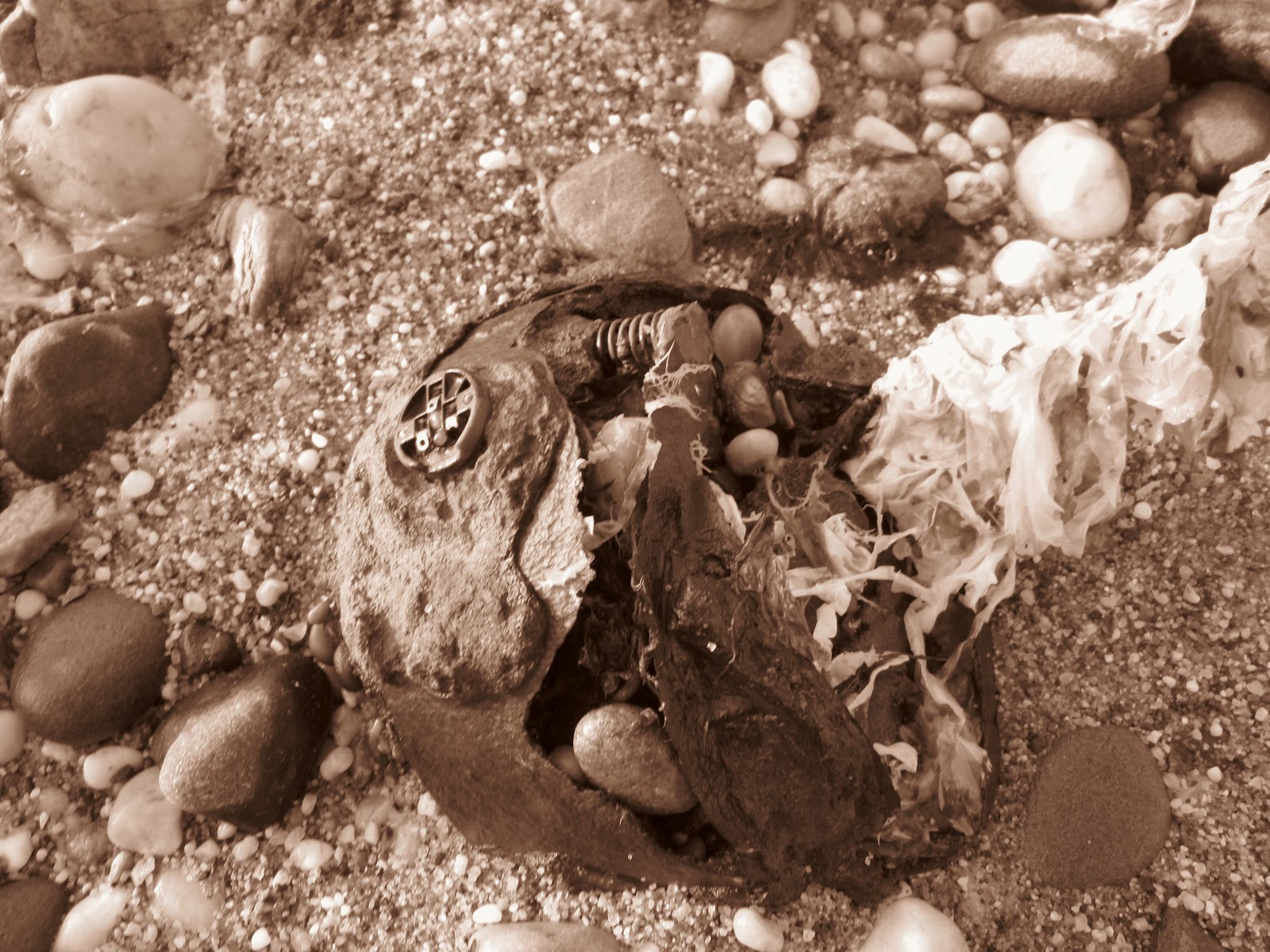
This looks almost like one of those early headpieces for underwater suits. Creepy.
Where does this stuff come from? Both disgusting and fascinating, I can help wondering not just where these things come from, but how long it takes them to become so rusted, and how they came to be tumbling over the ocean floor. Granted, the south shore of Connecticut is quite industrial, with many shipping ports. Nearby New York is no better. Things just fall off, apparently, and are dashed about by the currents until they are spit back out into our sand.
Stuck in the sand. No idea what this is.
By the time these remnants of civilization end up on our shore, they are utterly changed from their former selves, studded with rocks, coated in seaweed, broken and battered.

(Makes me think I should get my tetanus shot renewed. And that I could make a calendar with pictures of bizarre Long Island debris and sell it on Etsy.)

Of course, I hate this industrial litter. It's vile. Disgusting. Poisonous. But it's also fascinating, and maybe a little inspiring. They could be remnants of a lost underwater civilization. A litterbug Atlantis. They could be space trash that has fallen into the ocean and washed up on our shores. Maybe these elements rust so quickly because they are made of Terbinium and thus only adapted to the atmosphere of Mars.

Still, I do hope all that junk is gone by the time swimming weather arrives.
Huzzah for sunshine at 7pm!


Monday, March 12, 2012

Computer Games and a Gal Who Loves 'Em

And there might be better ways to waste your afternoon or evening, but I have been playing computer games all my living memory.  The appeal might have something to do with how solitary computer games are as, unlike consoles, they are in general played alone (MMORPGs excepted) and I have in general been more of a solitary than group activity fan.  I also make a point here by emphasizing computer games, as that is all I’ve really ever played and all I play now.  While my house had an Atari like every other middle and lower-middle class house in the U.S., that was the only console we ever had.  I don't know why, but no one in my family seemed to be interested in getting and Nintendo or SEGA, so I never played one.  The few times I was able to play the Atari I liked it, but, being the youngest kid, that was fairly infrequent.  While I was home earlier and more than my older brother and sister, I didn’t know how it worked and the only people who would show me wanted to play if we turned it on.  By the time I had figured out how to switch input from TV to the Atari, the Atari was old and uncool.  I do think I remember being fairly decent at Centipede, however.
Of course the Atari was more than a gaming console—it was also a home computer, with some of the earliest versions of word processors I remember using to type up my earliest stories.  I’m sure there were some computers in-between, but when my dad upgraded to a Tandy (4800?  not quite sure on the number—roughly 1987), I became interested in computers because he bought several games.  There are some single-screen games I can picture clearly that were a kind of combination MUD/graphic game.  You had to type in your directions like a mud, and there was little to no movement in the screen shot—just a picture with possible directions and typable actions, again like a MUD.  There was another game, however, that I wish I could remember the name of (Dragon Wars?  Dragon Fighter?), which was the next level up from this and very similar to the Might and Magic games I’ll examine below.  It had a first-person POV and you walked around as a party of role-playing type characters (thief, cleric, fighter, wizard) and solved quests and killed things.  The main difference between this and later games was the lack of detailed scenery.  There were walls for the cities and dungeons as you walked through, a map key to show where you’d been, and a few creatures to represent monsters.  Everything else was represented by some version of a statue or portrait that would say “Turn to Page 24 of your manual and read paragraph 3” for a description of what you were supposed to be looking at.

Next came the game that probably changed my life and brain forever: Sierra’s King’s Quest IV.  Having not played the previous games, I was initially uninterested in it.  As a firm, stubborn tomboy, I refused to have anything to do with “girly” things, and I read KQIV as girly because it had a female protagonist.  Eventually sick of the other games, I started playing it (I always referred to it as Rosella because of the main character), and Rosella changed the way I thought about games forever.  Not only is the storyline awesome, the puzzles complex, and the world fairly large for that era of games, it was wicked hard to complete.  My neighbor friend, K., would come over and play with me on the weekends and I’m pretty sure it took us a year to finish (I will add a caveat that most of that time was due to user error, as we often got stuck in places where it was difficult to move Rosella without killing her—we’d be stuck on some ledge or spiral staircase for weeks and weeks, screaming at the screen in frustration).  The following Xmas, I got The Conquests of Camelot, which is possibly my favorite game of the Sierra line.  I was always a big King Arthur and English history fan, so it seemed to me to be a game just for me.  A couple of months later I was also given Hero’s Quest (later renamed) for my birthday, an early—but not the earliest—role playing computer game, and between the three of them, K. and I were kept busy for a long time, finishing, if I remember correctly, all three suddenly and back-to-back in one long weekend go.  I remember I was so happy I actually cried when KQIV rolled it’s end sequence.  I also played the sequels to King’s Quest and Hero’s Quest, as well as Colonel’s Bequest (which I loved for the setting), Police Quest 4, and the Lucasfilm The Secret of Monkey Island (1990).


My next interest was first-person shooters.  When Wolfenstein 3D was released in 1992, just about everyone with a computer was glued to their seat for weeks.  I believe it was my sister that brought this one home through a friend, but anyway, I was immediately hooked in it and several of the great follow-ups, Doom (1993), Doom 2 (1993), Rise of the Triad (1995), Quake (1996), and my favorite, Blood (1997).


I was still interested fantasy and role-playing, partly because of a voracious appetite for those books at the time.  The Might and Magic series stepped in to bridge the gap between fantasy role-playing and first person shooters.  I began with Might and Magic IV: Clouds of Xeen (1994) and went on to play, over the next several years, all of the sequels, Might and Magic VI, VII, VIII and IX (1998, 1999, 2000, 2002).  These were and are the crème dela crème of fantasy games.  While Baldur’s Gate, Neverwinter Nights and Dragon Age would eventually replace them in ingenuity and complexity, these games, especially those from the 1990s, were incredible.  Huge sprawling countryside, coupled with giant dungeons, and completely alterable role-playing characters.  


Looking at these dates is occasionally very surprising, as I picture myself much younger when I was playing many of these, especially the last.  I’ve recently downloaded and replayed MM4-MM8, and one thing I’ve noticed and have noticed by replaying many of these games is that I still know where I’m going.  I can’t really express how big these worlds are, but I can tell you one thing, if I spent 15-20 years away from a place I might have lived once, I doubt very much I could navigate my way around like I can in these games.  I actually believe that videogames might have given me at least one thing: the ability to navigate spaces.  I very rarely get lost and can easily determine quicker routes between spaces once I’ve mentally mapped something once or twice.

Another strange thing: I remember the music and sound effects from these games like I was just listening to them yesterday.  I occasionally will find myself humming something and realize that it was the score of King’s Quest IV or Conquests of Camelot or something else.  This has led me to believe that my brain must look something like this:

Happy Gaming!
-KK