Friday, September 20, 2013

The Puppy Diaries: The First Week


For K.K. and I had always known we wanted to be pet owners. From the earliest times of our relationship we discussed all our hopes and dreams, and both of us were in agreement that pets—both dogs and cats—would be in our future. We adopted our kitty, Calliope, in the fall of 2010, after some friends of ours adopted one. When I saw their adorable kitten, I decided then and there that we would not wait another month. I wanted a kitten, and I wanted it now. After several weeks of driving around to different shelters (most depressing thing ever), we finally found our little tortoise-shell miracle in a cage by herself at a large shelter on Long Island. She was about 12 weeks old and quite the bundle of energy and delight.

Calliope was a grumpy cat before Grumpy Cat.
But we still love her!
(This is at about 4 months old.)
As much as we loved Calliope, we still wanted a dog. I had grown up without pets (I don’t count my guinea pigs, which were boring and stinky, mostly) but yearned for a cat or a dog or both. I had always vowed to myself that I would get a pet as an adult. Mostly I thought of myself as a cat person, but dogs appealed to me, too. Once I took up jogging on a more regular basis in grad school, I especially liked the idea of having a dog I could go jogging or on long walks with. K.K. had always had dogs growing up and was nearly mad at the thought that we couldn’t have one in our duplex on Long Island. It just wasn’t feasible there, however, since we had no yard, a neighbor downstairs, and a picky landlord. Our move to Tennessee, though, and the house that we found with a gigantic fenced yard meant that it was puppy time.
            We picked up Bingley last Saturday from a breeder near Athens, TN. (N.B. Cookeville is near Sparta, TN. I believe there is also a Troy and a Carthage, TN. So it’s not just NY State with its delusions of Homeric grandeur.) Long ago we had decided that we wanted a breed of dog that would be predisposed to pleasing his owners, a naturally friendly and low-key breed. Around the same time, I had proposed that if Mr. Bingley, the character in the Jane Austen novel Pride and Prejudice, were to be reincarnated as a dog, he would surely be a Golden Retriever since he was so friendly, and he always desired to please everyone. (At the same time, he was very obedient in listening to his good friend, Mr. Darcy.) Thus, it seemed the very pinnacle of perfection that we should adopt a Golden Retriever and name him Mr. Bingley.
I mean...he even looks like a Golden, amiright?
A week into puppy ownership, I have to admit I wasn’t exactly ready for what it all entails. All our friends kept warning us it would be a lot of work and pretty exhausting, but no one explained that it was more psychologically exhausting than anything else. Having a puppy in your house is like having a stranger come to live with you.  A stranger who cannot explain his needs at any given time. I find myself constantly guessing, “Is he hungry? Is he tired? Is he annoyed? Is he sleepy? Does he need to pee? Have we spent enough time outside today?” After the first two days, I went back and reread some sections of the puppy books we bought used off the internet, and I felt better when I realized that many people get a puppy and then go right back to work. Our puppy has the advantage that one of us was home almost all day long, since we teach on alternate days. Maybe I wasn’t such a bad puppy mommy after all. Similarly, the book explained (something I had missed in my earlier reading) that between 8-10 weeks, you cannot expect your puppy to do much of anything, obedience-wise. You are lucky if he doesn’t pee in the house or whine at night. (Bingley does neither, barring one small accident. But one accident in the first week seems fine to me!)
            Of course, Bingley is a little bundle of joy, too. He is probably the cutest thing with four paws every to walk the planet (except for Calliope when she was a kitten, of course). He looks a little like a teddy bear, and sometimes, when he’s rolling around on his back waiting for me to pat his belly, I swear he’s smiling at me. He’s especially adorable when he’s asleep, pooped after a day of chewing his toys, running around the yard, discovering all sorts of new smells, and occasionally growling at his trout-shaped chew-toy. But it’s hard not to smile when he comes running over to you, too, to say hello and give you a friendly lick. He’s still transitioning from being dog-oriented to being people-oriented—after all, it’s only been a week since he’s been away from his mom and dad and littermates.  But it seems like he’s adjusting pretty well. I look forward to the time when he’ll be ready to learn how to respond to commands, walk on a leash, and sit calmly when guests come to visit. (Right now he seems to think of guests as chew-toys…) For now, he’s just a puppy baby: sweet and cute even when he’s growling at a stick in the yard. And of course he’s tiny—he weighs just about the same as the cat!
Gaaaah! too cute!
And speaking of kitty…Calliope is slowly adjusting to having the pup around. We have a baby gate set up for now between the kitchen (Bingley’s domain) and the living room and the bedrooms (Calliope’s territory—for now). The first day, from behind her side of the baby gate, Calliope observed the dog in a position that clearly screamed, “I’m ready to run at any second.” Sunday morning, it was clear that Calliope had not expected that the dog would still be here. So far she has alternately ignored him, watched him carefully, hissed at him (he’s barked at her only once so far), and run away. Increasingly, she has become more curious. At first she would only come into the kitchen when we took the dog in the back yard. Then she would scramble awkwardly onto a counter and over the gate back into the living room. Last night, however, she boldly sauntered into the TV room, which is just off the mudroom/kitchen area, where K.K. and I were watching The Sopranos with Bingley asleep at our feet. While he slept, she hung out in the den, climbing up the couches, but always keeping a watchful eye on the dog. She didn’t hang around long once the dog started to wake up, but this could be the start (we hope) of an interspecies perestroika.

Monday, August 26, 2013

I Hang My Hat in Tennessee

It’s been just over two weeks since we moved into our new place in our new city, Cookeville, Tennessee.

I know, right? Tennessee.

It feels a little strange to be living in a “red state,” after living in one of the bluest states of all, New York (though upstate folks may have more in common with the average Tennessean than the average New Yorker!). Living in Tennessee, I am technically no longer married. I cannot give my job benefits to my partner. Tennessee has a state constitutional amendment prohibiting gay marriage and prohibiting the recognition of gay marriages from other states. When the amendment passed seven years ago in 2006, approximately 86% of Tennesseans disapproved of gay marriage. The most up-to-date polls put the number now at 64%, which is still higher than the South in general, which is at 54% disapproval.

It’s also legal in the state of Tennessee to evict someone for being gay, or to fire them for being gay. While I don’t think that those last two points will be issues while we live here, it bothers me to no end to think about how our beautiful vows to one another are legally irrelevant in my new state. I also have to try not to think about the fact that both of our current Tennessee senators and 5 out of 7 congresspersons are Republicans (including the representative of the 6th district, which Cookeville belongs to).

I’m trying not to focus on these particular realities too much, however, since the politics of a state are not the end-all, be-all. So far, I’ve discovered quite a few perks to life in Tennessee. First of all, there is no income tax.

Wow. I didn’t even know there were states where there wasn’t any! That’s a perk, even if the sales tax is pretty high in order to make up for it, at 7% minimum in the state and higher in some parts, like Nashville, where the sales tax is 9.25% (that’s higher than New York!).

Registering a car is also similarly, laughably cheap: $38 to register a car for the first time in the state, tags & everything. Nice! Maryland is four times that. Of course, our rent is also incredibly low. We pay half of what we paid on Long Island, but we have our own house with a gigantic backyard. We are also close enough to school to walk or bike if we want to. In fact, Cookeville is small enough that you can drive just about anywhere in five minutes—unless you get stuck behind a school bus, of course.

So, things are cheaper here. People are also much friendlier. That’s not to say that people in Maryland or New York aren’t friendly! What I mean to say is that people around here are polite, very polite. Everyone says “ma’am” and “sir”—everyone. It’s kind of nice. “Yes, ma’am.” “No, ma’am.” I could get used to that. Most people are also pretty chatty. I still have my NY driver license (changing that tomorrow!), and when I have to show it to use my credit card (yep, that’s happened quite a few times here), people’s reactions are pretty much uniform:

New York! Well, you’re in for a culture shock!...But I think you’re going to like it here. Cookeville is a great place to live.”

I think it’s a pretty good sign when the locals are trying to sell you on the place where they live.

*
Our first week here was surreal. The house seemed foreign and strange, the grass needed to be mowed, we had no furniture, and the cat was going crazy with fleas. The stuff that we managed to bring with us was scattered all over the house, and we ate pizza dinners on camp chairs we had brought with us—our only chairs. We slept on an air mattress and killed roaches constantly for the first three days. It was not fun. I knew the roaches would eventually die from the exterminator juice and our real mattress would arrive soon, but it seemed hard to remember that in those first 3 or 4 days.

Our third day the cat caught a lizard in her mouth. It squirmed until she bit its tail off and let it go. Then it was scampering like mad up and over all our junk that was scattered around the living room. Its tail lay on the ground, still moving in a little S shape. That incident did nothing to shake how surreal it felt to be in a new place with virtually no belongings.

Finally we began to acquire some stuff. Some housewares and second-hand furniture. We gave Walmart a good chunk of our savings (there is no Target in Cookeville, something I still can’t get over!). We went to so many stores so many times that I went to bed dead tired every day feeling that I never wanted to go a store again. But we had to. We had jettisoned almost all our stuff in the Big Move from New York to Maryland, from Maryland to Tennessee. Some of our stuff is still in Maryland, and some of it is in Colorado, where we sent stuff we thought we would need when we moved there. That’s how late we got the news about Tennessee.

After 4-5 days the house was more habitable. The roaches stopped showing up so frequently and the house was tidied up. We got the internet going and were connected to the world. We got some pots and pans and cooked in our own home again. To celebrate our first week in Tennessee, we drove for a day trip to Nashville. There we checked out Broadway with all its tourist shops, honky tonks, restaurants and river views. We ate delicious food at Merchant’s for lunch and checked out some vintage cars at the art museum, the Frist Center. We hiked up the hill to see the Ryman Auditorium and the Tennessee state house, only to return to Broadway and get some margaritas at Margaritaville—of course. We drove over to Opryland for dinner in Opry Mills at the Aquarium Restaurant and strolled around the mall. I noted with joy that Opry Mills has all my favorite brands (yes, that sounds incredibly consumeristic but clothes shopping in Cookeville consists of Sears, JCPenney, Old Navy and TJ Maxx).

A day in Nashville made me wish a little bit that my job was in Nashville. Nashville had a great vibe—artsy, musical, a little divey…definitely a city. And certainly some of the faculty live in Nashville and commute to Cookeville, just like at my old job where people lived in NYC and commuted to the university. But commuting has never interested me…and really, for a smaller city, Cookeville is pretty nice.

Cookeville has a tiny little downtown with some boutiques, antique stores, restaurants and pubs. The restaurants I have been to so far have had great food and extensive drink selections. There are several funky coffee shops with wifi that are not Starbucks (though there is a Starbucks in town too) as well as at least two local bookstores. The area by the highway has most of the recognizable restaurant names, including multiple  fast food joints, diners, and places like Chili’s that we all recognize and reach for in times of need. It is also big enough to have its own public library, theater, orchestra, multiplex movie theater, and Shakespeare in the Park. And maybe I exaggerated a little bit about the shopping—there is quite a bit here.

On top of all that, there is the university right in the middle of town. Everywhere you go, you see discounts for students and faculty members. There are posters that say “Purple Pride” all over town, and there are signs all around the edges of campus reminding drivers of upcoming football and soccer games. The presence of a university also helps insure greater diversity and open-mindedness in general. We’ve even seen several cars with HRC stickers around town.

All in all, I’m feeling much better now than I did two weeks ago. Cookeville is seeming more like home. Our house is comfy and pleasant and we’ve even hosted some people from work. We’ve been out and about to campus meetings and orientations. Things are moving forward and looking up. Of course, I don’t start teaching until tomorrow, so who knows what my perspective will be like in 24 hours! But that’s a whole different blog post…

Historic Downtown Cookeville at twilight.


--UK

PS In case you were wondering about the title of the post, it comes from a song by George Strait, “All my ex's live in Texas”:


“All my ex's live in Texas
And Texas is the place I'd dearly love to be
But all my ex's live in Texas
And that's why I hang my hat in Tennessee”

Wednesday, August 14, 2013

Kiss Me, I'm Polish

At the end of June I traveled to visit family in Poland. My parents immigrated to the US before I was born, so my brother and I were born here. We were both taught Polish and steeped in Polish customs and traditions. We were brought up to feel proud of our Polish heritage, and I was lucky enough never to hear a Polish joke until I was a teenager, at which point I had only scorn for the teller, rather than shame for myself. In fact, it was as an adolescent and teen that I became conscious of how extremely lucky I was to grow up with a second language and a second culture, not to mention all the trips to Europe that came with having family abroad.
Poland.
It looks a little like Ohio, but it's roughly the size of New Mexico
with a similar population to the country of Spain or state of California.

            Many people in the US who are not white and/or have an accent are often immediately pegged as “different”—my parents, for example, get asked in our very own hometown where they’re from, even though they’ve lived in the States for over 30 years. I, on the other hand, often “pass” as American, whatever that means, until and unless a conversation arises about foreign language skills, travel, or ethnicity. Despite my fluency in Polish, my trips to Poland, and, most importantly, my Polish-American dual citizenship, I have often had people say to me, “You aren’t Polish. You’re American.” Perhaps this is true in the sense that I have lived most of my life in the US; however, there is a very big part of me that feels intimately connected to Poland and being Polish. 

I always get excited when I see signs of fellow Polish-Americans.
I took this photo of a Polish flag flying below the American & Colorado flags at what must be
a Polish-owned motel in Glenwood Springs, CO.
            For these reasons, and many others, as an adult I’ve made every effort to go to Poland as frequently as possible—usually no less than every two years. As a college student, I studied abroad there for six months, and after college I taught English there for another eight months. Aside from that, I have visited four other times as an adult. Most recently I went for nearly three weeks just over a month ago. When I go, I usually stay with relatives, though I have made concerted efforts to visit other parts of Poland also. On this trip, however, I concentrated my time in my mother’s hometown, where my grandmother still lives. She is elderly and fragile, and I wanted to spend as much time with her as possible.
Wroclaw, where I studied abroad in college and later taught ESL.
            My grandmother is pretty amazing. She was a teen during the Second World War, and she loves reminiscing about her girlhood, the war, and her parents. My great-grandfather, her father, was killed by the Soviet army in Katyn. He was a medical officer in the Polish army, and, like thousands of others like him, he was executed in a forest and dumped in a mass grave as part of the Soviets’ plan to eliminate army officers and the Polish intelligentsia so that Poland would be ripe for the conquest once the Nazis were done with it. My great-grandmother spent the war struggling to make ends meet with my grandma and her younger brother (my great-uncle) in Kraków, where they were sent by the Nazis, who kicked them and many others out of their homes at the start of 1940 in Kalisz. I try to imagine what that would have been like—to be taken from your home at the age of 13, not knowing what has happened to your father, allowed only a couple of suitcases of your things, and taken by passenger train many hours to an unknown city during wartime… And yet that was her life. From 13 to 18 she experienced the war in all its dangers and vicissitudes. Her regular schooling, like that of millions of young Poles, was turned upside down. She was lucky to be able to get a tutor and later to attend a business high school in Kraków—the only kind the Nazis would allow to function during the war.
            Before the War, my grandma and her family lived a quiet, contented upper-middle-class life. My great-grandfather had a thriving medical clinic in Kalisz, and many of his clients were Jewish. They spent the summers in the country or at the beach. There are many photos of my great-grandmother and her sisters in fabulous dresses and hats from the 1920s and ‘30s. She had a beautiful fox-fur coat as well, which the Nazis would not let her take with her to Kraków. My grandma reminisces about the housekeeper they had before the War, who would make her breakfast. Together we looked at a photo album that my great-grandmother put together, full of photos of my ancestors and relatives, my grandma recounting to me all the family histories that she could remember, including the story of my great-uncle Zbyszek, who died a war hero during the first days of WWII when his plane was shot down by Nazis. His godmother had named him Stanisław Florian despite the parents’ wishes that he be named Zbigniew. Everyone in the family called him “Zbyszek,” and the mistake was never discovered until he enlisted in the Polish Air Force!
            My grandma and I also spent a lot of time listening to Classical music on the radio or watching ballets and operas on TV during my visit. She is extremely well-read, and she keeps up with the news of the world, so we spend a lot of time discussing the state of the world, literature, ballet, art, opera, composers and music. Together we even attended a concert by the local symphony while I was visiting. Though she may not be very active physically any more, mentally she is sharp as a tack, and I am always so grateful to have such a wonderful relationship with her.
The main square in Jelenia Gora on a cloudy day.
An old tram car serves as the tourist info point.
            On my father’s side, both of my grandparents are dead, and I never had the chance to have an adult relationship with them. My father’s sister, however, is alive and well, and I visit her and my uncle whenever I’m in Poland. They are world travelers who have been to many unusual and exciting locations: Egypt, Nepal, India, Tibet, Peru, Morocco, Indonesia, Iran, and China, among others. When they travel, they focus on taking in the natural beauties of the country they are visiting. They have hiked in the Himalayas, the Atlas Mountains, Macchu Piccu, and been to the highest peak on Cuba. They use local travel agencies to avoid tourist traps, and they are avid photographers, so there is always at least one or two sessions of looking at photos from their most recent trips. This time, my aunt showed me her photos from two different funeral rites in Indonesia—a Hindu funeral and a Muslim one. I also revisited her photos from Cuba, which were from the era when my aunt and uncle still made prints of photos and put them in an album. A visit to their place wouldn’t be complete either without French wine and fancy cheeses, as on their “off” travel years they take their vacations in various European mountain and wine regions. What a life!
            As if all this goodness wasn’t enough, my aunt and uncle also took me on some hiking excursions during my visit. I have hiked in the Karkonosze mountain range, part of the Sudeten Mountains, many times, as they are very close to where my grandmother lives. For a change of pace, we hiked Mt. Ślęża and the Góry Stołowe near Kłodzko. Mt. Ślęża is part of the Sudetes foothills, but it really seems like an anomaly, as there aren’t any other hills or mountains around it. Probably for this reason, the pre-Christian Slavs thought the mountain was sacred and used it in their religious rites, and there are several small rock circles on the mountain still in existence. In the Kłodzko Valley, we toured the Chapel of Skulls, an 18th century chapel filled with skulls and bones of people who died during the 30 years’ war as well as from the plague. Creepy and fascinating at the same time, especially since it is still a working chapel. The nun who gave the tour pulled up the trap door and showed us all the bones under the chapel, and she also showed off a couple of particularly creepy specimens of bones, such as a bone that had broken in half and grown together crooked, as well as a skull with a bullet hole through it. The rest of the day was spent hiking, first the Błędne Skały, or “Rock Labyrinth” and then the mountain named Szczeliniec (The Chink), for all the large boulders and funny chinks in the rocks. Both hikes were fascinating in their geological oddity.
The sign for the Skull Chapel.

A tight squeeze in the Rock Labyrinth.
            The end of my trip arrived all too quickly. All my Polish friends and family wanted to know when would I return and would I come with my partner next time (the tickets were too expensive for both of us to go this year). Some relatives even asked me if I would ever consider moving to Europe or Poland again and working there. The idea is not a new one for me; sometimes I wonder what my life would have been like if I had stayed in Poland after college instead of returning and moving to New York to do my MA in English. That’s another path untaken; who knows, maybe someday I’ll have that opportunity again. But even if I never return to live there, I know there’s always Poland in my future as well as in my past and present, because I’ll always be Polish (-American) and proud of it.

Wednesday, July 31, 2013

The Sob Market

Transitional stages in life are often the toughest. After being safely ensconced in a particular way of life for a period of time, it is often depressing and anxiety-inducing to be faced with a major change. For me, these periods of time mostly have to do with finishing a degree of some kind and embarking on the next challenge.
            In the past, the “next challenge” was fairly predictable. When I finished high school, I knew I was heading to college. When I finished my Master’s, I was already accepted in a PhD program. The end of my BA was a little different, in that I had no schooling or employment immediately lined up. This problem fixed itself fairly quickly, however, once I decided I would go to Europe to teach English abroad. Not that that was a simple time, as moving to another country, doing an intense certification program, and finding housing and work were not easy tasks, either. Those moments of uncertainty were ones that I thought of frequently in this last year, while I was on the academic job market.
            What’s different about finishing a PhD, however, is that for most of us, this is the terminal degree. There are some crazy people out there with multiple PhDs—this is not in reference to them. For many of us, the end of the PhD is the end of our formal education. From now on, we will no longer pay tuition, no longer have student ID cards, no longer attend classes as students. In English, the aim is to become the teacher—the professor at the head of the class. Even when I was finishing my BA and wondering what the heck was next, I knew that somewhere in the offing was a grad school degree I would return to do. I wasn’t sure yet what it would be, but I knew it was there. The end of the PhD and the looming student loan payments meant that it was time to seek gainful employment. After 12 years of post-secondary education, you might say, it’s about time!
            Even before I started a PhD, even before I applied to PhD programs, I knew that the academic job market was…ahem…not great, to say the least. There is an entire long-winded debate about this problem and how we should deal with it (discourage people from applying in the first place? cut PhD programs? change tenure policies? figure out a way to train PhDs for work outside academia?). This post is not about that. It’s about the reality of finishing a monumental challenge—a doctoral degree—of which you and your loved ones are immensely proud, and then feeling immediately devalued by the dearth of job offers that follow. I knew that it would be tough, but nothing could prepare me for the months of feeling rejected, hopeless and rather terrified that I would never…ever…get a job in my field of expertise.
            Our nation has been in a recession almost since I started my PhD. I started in the fall of 2007 and the big crash that marks the official start of the recession was in the fall of 2008. Almost immediately my institution—like many others—instituted a hiring freeze. All of a sudden, I and many of my peers felt very grateful to be in grad school and not out on the streets, looking for jobs. I had various friends and even family members who had tough times finding full-time jobs, and I sympathized. In the last year, however, that sympathy turned to empathy. It seemed there was nothing worse than sending out application after application (the drafting of an individual cover letter and preparation of secondary required documents could take anywhere from half an hour to two hours per application) and getting absolutely no feedback.
            In the fall, it was disappointing. I mean, I knew my chances had been pretty low given that the jobs advertised in the fall for full-time positions were extremely competitive. So I tried to give it a pass. I redrafted letters for the spring and focused on a wider variety of jobs ranging from temporary, visiting, and tenure-track appointments. And still, until March, there was nothing but silence. One phone interview in March improved morale briefly, until it became obvious that there was going to be no call-back. I defended my dissertation at the end of March but felt that there wasn’t much to celebrate if I had a PhD but no job. The only thing to do, however, was to keep trying.
            Every once in a while I would get an actual rejection letter, but most of the time my applications were met with silence. In the silence, you start to wonder: what did I do wrong? Do I have some glaring typos in my cover letter or CV? Is it because I didn’t go to an Ivy? Is it because I’m not local to the job? I had no idea. Getting a job started to feel a little like winning the lottery.
           I felt adrift on a sea of uncertainty, one storm away from getting smashed against the rocks hidden under the waves. I started to wonder if I should consider other careers. Could I use my language skills to work for the Government? Would I make a good school teacher? Maybe I should use my party planning skills at be a wedding or party planner? I had to keep reminding myself that it was normal now to have to work part-time after a PhD and to apply for two or three years after the degree to find a permanent job. This wasn’t the end of the line, even if it felt like it.
           Finally in June things started to pick up. I had an article accepted by a journal and another article sent to a peer review.
          And I got an interview. It went extremely well.
             I finally got a job offer.
             Relief….so much relief. It seemed that with one phone call, with one interview, I could forget all the worry, heartache, depression of the application process, the 100 jobs I applied to and all the rejection that they entailed.

            I think, however, it’s important to remember that sense of being unmoored, rudderless, lost. Many of us tend to think of our lives as a straight line, an arrow beaming into the future, always advancing, always improving. We are supposed to be wiser, smarter, and more cautious as we age, moving swiftly past the mistakes, the foot-in-mouth moments, the disappointments. We want to believe that our identity is something tangible, inalienable, defining. This, not that. But the moments of transition reveal the ludicrousness of these beliefs. The start of a new adventure is the start of new joys, but also new mistakes and new frustrations. Similarly, the sense of being directionless or adrift reminds us that there are many possibilities for ourselves and our future, and that we must be prepared to makes changes and be flexible if things don’t turn out as we planned. It’s not necessary a bad thing, though I certainly don’t advocate jumping ship as soon as you lose sight of land, either. There can be satisfaction in seeing the uncertainties through and come out on the other side.
--UK

Monday, June 3, 2013

New York Trilogy: Au Revoir Empire State

So...Every so often, I enjoy writing a poem, especially for a special occasion. Here are 3 I penned to say good-bye to New York City, graduate school, and Long Island, in that order.
--UK

NEW YORK TRILOGY

Leaving New York:

New York,
I have been leaving you since I arrived

Don’t take it personally,
but now I’m really going.

No more afternoons in the park
Evenings in the Village
Midnight taxi rides
or museum expeditions.

We had a good run
we even tried a commuter relationship.

It’s time to admit
we weren’t right for each other
we come from different worlds.

It’s not you, it’s me.
Or maybe it’s you.
Dirty, unrelenting, expensive
with a smelly underbelly.
Offering hope
Only to snatch it away.

I just can’t do this anymore.

I hope we can still be friends.


Notes Accumulated Over Time (Graduate School Year by Year)

Prelude: Letter of Acceptance
Thank god!
Someone wants me after all.
I’m going to be an Academic!
I’m going to live on books and
Important Conversations!
They are paying me to be a
SCHOLAR.

1st year:

Pleasure & pain intertwine
Combine

Easy camaraderie
Important Conversations
Beer & blowhards

Inevitable housing issues
Inevitable Foucault

So grateful to be here.


2nd year:

Classes?
I’m so over them
I’m ready for the next thing
next year
next challenge
next next next please!

That damned Foucault is still following me

I had to take out loans;
What they pay is a pittance

At least teaching is less boring
than TAing.

3rd year:

Shouldn’t reading all day long
be more fun than this?

I’ve developed a permanent twitch in my hand
from typing notes

Exams

What a mess

Then: So…what’s your dissertation going to be about?


4th year:

Indecision
Derision
Research more:
Confusion

From out the miasma
an Idea emerges

Careful, they say: you’ll have to live with this one for the next ten years.

Write a proposal:
Immediately trash it.
Start the first chapter.
Move on.

Interlude: Summer work study

What am I doing?
How many hours?
How do I log them?
When do I find the time for my work?
Whose idea was this anyway?


5th year:
A recipe:
Research
Write
Repeat

First years don’t know who you are.
They look so little.

And hopeful.

6th year:

Edit.
Edit edit edit
edit edit edit edit

Frantically apply for jobs

Set the date.

Edit edit edit edit

Defense: Speak. Answer questions.
This is it?

Congratulations! You’re a doctor.
I’m a what?
Aren’t you so relieved?

I need a job


The Long Good-bye

Long and blue and green
Sprinkled with turquoise
pools and long
ribbons of congested highway.
seen from above
a lobster claw
a whale

The first thing I noticed
were the trees
canopied above
bursting flowers
water blue sky
beach access
quiet neighborhoods
--the opposite of Brooklyn

upon closer inspection—
there are no sidewalks
food and gas and heat
and housing and everything
costs. so. much.
summer traffic is murder:
2 hours in the car
to go to the Hamptons—
it’s just stores.
outsiders don’t live here;
we merely survive.

How will I remember it?
This place with
good pizza
ocean breezes
views of Connecticut
hazy in the distance
ferry boats
wine country
hiking flat forest trails
taking the train to the City
News Channel 12:
As local as local news gets.

Perhaps

I look forward
to friendly locals
People who smile at you
for no reason.
Who say “please” and “thank you”
I look forward
to non-aggression

But I will miss the blue
And I will miss all of you

Farewell little island
that is not so little
for it is Long.

Farewell the
drawers
dogs
coffee
and chocolate

I stayed for a while
Longer than I expected
now I’m longing to leave;
I’m leaving you.


Good bye.

Monday, May 6, 2013

Geek Chic in the Classroom


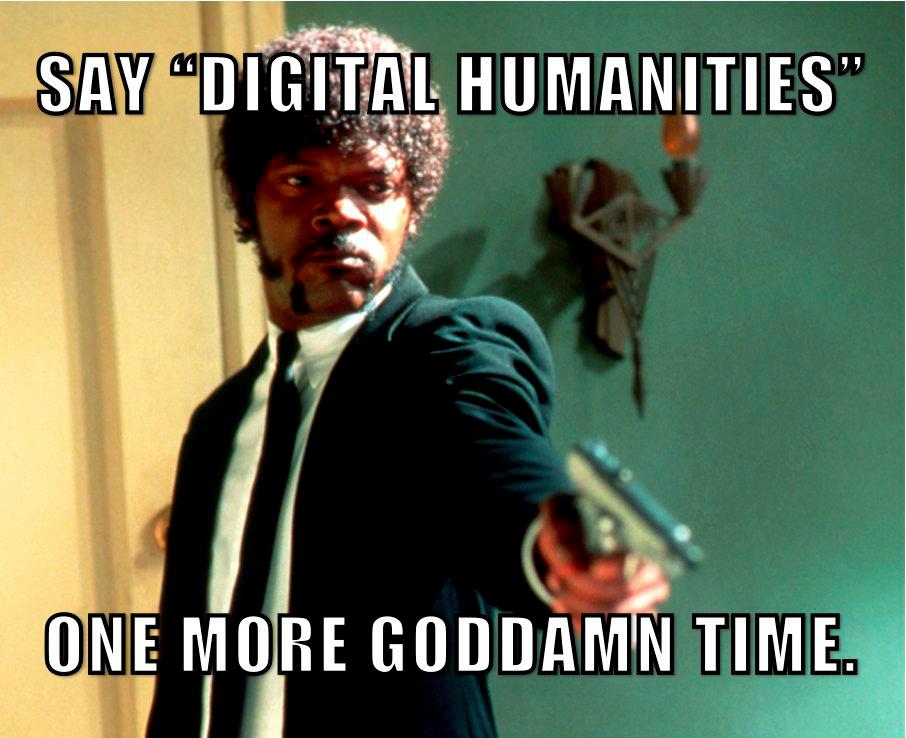
I generally don’t think of myself as a person who is “web-savvy.” While I have dabbled here and there with various programs and I took some programming classes in high school, mostly I stick to the “holy three”: MS Office, Internet browsers, and some very user-friendly photo-editing programs. With the advent of “Digital Humanities,” a movement in the academy that functions mostly, I think, to make us Ivory Tower dwellers seem like credible sources of income to University administrators, I have felt somewhat behind. My web presence is minuscule and cannot, I thought, compare to that of even the most backward of Millennial-gen kids out there.

This meme sums up my usual feelings for the term "digital humanities."
I mean, no one really knows what it means...So stop using it!
I mean, this new generation, the generation I’m currently teaching—you know, the kids who never breathed a minute of the 80s?—never lived during a non-Internet era. They grew up AIM chatting, emailing, and texting. 9/11 is something that happened when they were ten years old—or younger. They probably never used dial-up internet, never used mIRC or ICQ, never had to worry about mom and dad picking up the house phone and disconnecting them from a Very Important chat room discussion.

From what I read about on the web and hear on the radio and TV, this generation is connected: Facebook is the least of it. They Twitter, they Instagram, they blog, they code, they make podcasts and seek fame through YouTube videos. In class, I see them frequently take a photo of what I’ve written on the board instead of writing it down. They use Ipads to take notes on (if they bother to take notes), and nearly all of them have smart phones. They freely admit to being addicted to their phones and most of them walk around campus with an ear bud or two connecting them to their playlists.

So I am consistently flabbergasted when students display a basic lack of computer and Internet know-how. Without fail, they don’t know how to insert page numbers, alter margins, or run spell check (though that last one might be pure laziness). Despite having a powerful resource in their purse or pocket, they regularly forget? refuse? can’t be bothered to? look up a word in an assigned text that they don’t know. Even if the word is in the title of the story we are reading.

Now, you might say, well, these examples merely point to the laziness of the Millennials, their sense of entitlement, or their lack of basic learning skills that resulted from No Child Left Behind and its emphasis on testing over teaching. So I now progress to the more pointed examples. In the last two years, the writing program at my institution has changed over from paper portfolios to ePortfolios through a website called “Digication” (terrible word). This saves pounds and pounds of paper and is much easier to grade as well, as instructors are liberated from having to carry around said portfolios. The portfolios take a little bit of manipulation on the part of the students, as they require one to use Google Drive, to change the privacy settings, and then to link the documents to the appropriate spot in the ePortfolio.

Mind you, Digication is a very intuitive. It’s been years since I built my own website, but the interface on Digication is probably easier than that of MS Frontpage, which I used back in 2003. Pasting in the links consists of highlighting the word you would like to function as the link, pressing the button that says “insert link,” and then pasting in the hyperlink—much like on a blog interface. I was somewhat stunned when students had me running around the classroom today, troubleshooting the most basic of issues. Suddenly I felt like a real web babe, capable of figuring things out on my own in the wacky web world! I felt something I had never felt before: I know web stuff! And more importantly, I’m not scared to learn more if called on to do so. I grew up tinkering with the web and computers: maybe not as much as others who might have what we call a “natural talent” for the thing, but I've had my fair share of tinkering.

My students seem to have no sense of tinkering, of fiddling with something long enough until a solution emerges. They simply raise their hands when they can’t figure it out and ask for the answer. In the case of the ePortfolios, the answers were so simple, I wondered that my students weren't somewhat embarrassed to have asked. One student even asked how to insert page numbers into a Google Doc, to which I replied, “Hit the ‘Insert’ button.”

Aside from my frustration with their over-reliance on my hand-holding (I showed them how to do this as a class, first, and they still needed my help for the entire class period) and my disappointment in their lack of “tinkerage,” I ended up feeling quite proud of myself. I can fiddle! I can tinker! I could take a class and learn more about different kinds of software if I wanted to! Don’t get me wrong…I’m not going to take up any kind of hardcore programming any time soon. But I felt enlightened by seeing their limitations. Their limitations reminded me of my own skill set, and that I am not as limited, technologically, as I thought I was. Digital humanities? Bring it on! Web presence? I’ll show you web presence!

I’m one viral video away from a full-on interweb takeover.

-UK

Friday, March 15, 2013

Don’t Dis the Diss—Part II: Walk like a Man, Talk like a Man


Despite my title, no, this entry is not about being a woman in academia. Instead, it is about the topic of my dissertation: eighteenth-century female cross-dressers.

If that sounds like a confusing mouthful, let me break it down a little. First of all, literary studies of the eighteenth century focus on a time period slightly longer than the actual seventeen hundreds. The Long Eighteenth Century can encompass nearly 150 years, anywhere from 1660 to 1837, with the ascension of Queen Victoria to the throne. My own dissertation takes the Restoration into account, but most of the texts I analyze were written and published roughly between 1700 and 1801—more true to the idea of the eighteenth century I suppose. It may also be useful to mention here that my focus is on British literature almost exclusively, despite the fact that there were women dressing in men’s clothes all over Europe and North America at this time. Probably in the rest of the world, too.

But I digress, as usual. Specifically, I am looking at literary representations of women who wore men’s clothes, whether they are actresses (who were finally allowed onto the English stage starting in 1660), novel characters (usually ladies who dress in men’s clothes out of necessity or pleasure), female soldiers (women who passed themselves off as men in order to join the army or navy—these are historical figures), female husbands (women who passed themselves off as men in order to seduce other women—usually their stories are elaborations on facts), or female pirates (pretty self-explanatory). Their stories were highly popular in the eighteenth century, and some of the real life passing women were quite famous. Female soldier Hannah Snell returned from duty, collected her pension, declared she was a woman, and eventually performed military drills on stage in her uniform. You could even buy a printed engraving of her to hang up on your wall if you so fancied. Female soldiers like Snell were often considered heroes who virtuously protected their female bodies from the sexual advances of men, showed considerable bravery in the field, and were often thought of as even more valorous than the men they fought alongside.
Hannah Snell! Don't you just want her pic on your wall?

Female husbands, on the other hand, were considered wicked cheats who pulled the wool over innocent women’s eyes, stole their money, and maybe even indulged in unnatural pleasures with the help of a dildo (not lying! It’s true!). These women were often castigated and, if caught, were publicly whipped and/or put in prison for deception. Similarly, female pirates Mary Reade and Ann Bonny cross-dressed in order to pillage and destroy as pirates, and to have affairs with the dashing pirates they met (women were often not allowed aboard ships for superstitions reasons. Also, being the only woman aboard a ship full of sex-starved men was not a good idea either). These women were also considered hussies and criminals.
Female Pirates Ann Bonny and Mary Reade.

 Novel depictions of cross-dressing were similarly ambiguous. Moll Flanders cross-dresses in order to steal; she doesn’t like the disguise, though eventually it saves her life because no one can identify her after a job goes wrong. Her male disguise is only one of many, however, and we don’t get the sense that Defoe thinks that dressing as a man is any worse than passing herself off as a lady. By the time Elizabeth Inchbald pens A Simple Story in 1791, Miss Millner’s ambiguously-gendered masquerade costume causes a stir over its unseemly show of leg while illustrating her ambiguous moral standards. (Showing leg was taboo for most eighteenth-century women, especially ladies.)
Showing leg was often associated with prostitution for women, as in this James Gillray print from the late 1700s.

In my dissertation, I consider these representations as part of a continuum. When I read more closely, I began to see a pattern in the way that the cross-dresser’s body appeared in the texts. Eighteenth-century narrative can be remarkably coy about people’s bodies; the cross-dresser’s body, which would seem to be at the forefront of her story and how she manages her male costume, only ever appears in fragments. The narratives I explore bring up certain appendages or body parts only when there is a question about the cross-dresser’s gender. In each chapter I explore a different appendage in order to further establish how gender functions in the eighteenth century.

What has made my dissertation so much fun is exploring precisely how eighteenth-century Brits felt about beards, breasts, penises, dildos and legs, and then comparing those attitudes and cultural representations to the representations in literature. Upon inspection, it becomes clear that although many writers, physicians, moralists, newspaper writers, and the general public felt that beards and penises denoted maleness and breasts denoted femaleness, these assignments were not always so clear. Although both men and women have legs, the texts I explore suggest that they only signify sexually on women—even as their exposure comes primarily when women don breeches.
Actress Peg Woffington was famous for her "breeches parts" on stage. She often dressed in men's clothes to recite epilogues to plays, such as this one "The Female Volunteer." Sexy, eh?

Ultimately, these appendages lose their ability to signify one gender or another. The texts try to maintain gender dichotomies, but cannot. Instead, their ambiguity becomes the way through which the cross-dresser appeals to other women. Her body is at times exposed, at times hidden, but either way, she is very attractive to other women. These relationships between the cross-dresser and the women she comes into contact with form the second half of my analysis. I argue that although not all the relationships between the cross-dresser and her accomplices are sexual, there is always a little bit of sexual tension—just enough that we, as readers, learn how to read for these nuances. Call it eighteenth-century gaydar, if you will. The cross-dresser’s gender-ambiguous body is attractive to and attracts other women. Whether they know she is a woman or not doesn’t matter; the reader always knows.

Whether she was on the stage, on a ship, or in another lady’s bed, the female cross-dresser is an intriguing figure in the eighteenth-century. In a time when readership is growing and women are increasingly picking up paper and quill, the figure of the female cross-dresser comes to represent the freedoms and restraints that women of the time faced. This is not to say that there weren’t other kinds of women who tested the boundaries of social norms, or other kinds of women who engaged in Sapphic practices…it’s just to say that our understanding of women’s lives and desires, and their representations in literature, are incomplete until we look a little more closely at the female cross-dresser.
Female Husband Mary Hamilton from Fielding's The Female Husband gets whipped in punishment for her crimes.